This workflow uses Okta's Groups API to assign one user to one group after Anyshift enriches the request with production reachability context.
Access Changes Need Production Reachability
Okta is the system teams trust for identity, users, groups, applications, and policy. Groups are the natural place to manage access: a user joins a group, and that group can unlock apps, workflows, and downstream systems.
The missing layer is not identity governance. It is downstream production reachability.
If someone asks to join Production Access Demo during an incident, Okta can tell whether the user exists, whether the group exists, and which applications or policies are attached to that group. The production question sits one layer further out: what does that access reach once it crosses into cloud roles, Kubernetes workloads, service ownership, monitors, and incident tooling?
For this sandbox, the useful path is:
Okta group -> assigned app -> AWS IAM Identity Center role -> Kubernetes workload -> service owner -> production monitor
Anyshift adds that reachability layer around the Okta change:

The Native Okta Object Is Still The Group
The workflow request is simple:
annie do "map production reachability before assigning okta-demo-user@anyshift.io to the Production Access Demo Okta group"`annie do` is Anyshift's reviewed workflow surface: it turns the access request into a reachability-enriched plan before the Okta API performs the native write.
Before any Okta write, Anyshift reviews:
- the target Okta user;
- the target Okta group;
- the production services reachable through that group;
- cloud and Kubernetes resources behind the access path;
- monitors and recent changes that make the access sensitive;
- skipped non-production systems.
Enrich First, Then Okta Writes
annie do turns the request into a five-step plan. The first useful artifact is not YAML; it is the production reachability review: which systems this group can touch, which team owns them, and which operational signals sit behind the access path.

For the workflow access group, Anyshift attaches production evidence like:
checkout-api: owned bypayments-platform; reached throughOkta group -> AWS IAM Identity Center role -> prod-payments-admin; tied to the Kubernetes deployment, AWS role, and checkout monitors.graph-connector: owned byplatform; reached through deploy and dashboard access; tied to the graph sync deployment, AWS collector role, and graph sync monitor.
That is the enrichment Anyshift adds. The access decision is still an Okta decision; the operator now sees the production systems and owners that sit behind the group.
After the operator accepts the plan, the runbook uses Okta's own API surface:
- `GET /api/v1/users/{id}` verifies the user.
- `GET /api/v1/groups/{groupId}` verifies the group.
- `PUT /api/v1/groups/{groupId}/users/{userId}` assigns the user to the group.
The sandbox workflow uses an Okta API token in the local environment. Okta's docs describe the SSWS header used for API-token authentication, and also recommend scoped OAuth 2.0 for stronger production deployments. The important boundary is the same either way: Okta owns the identity write; Anyshift supplies production reachability before that write.
The Result In Okta
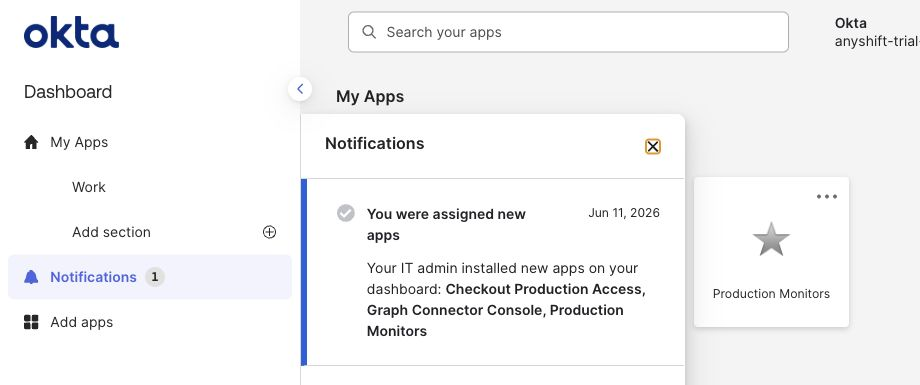
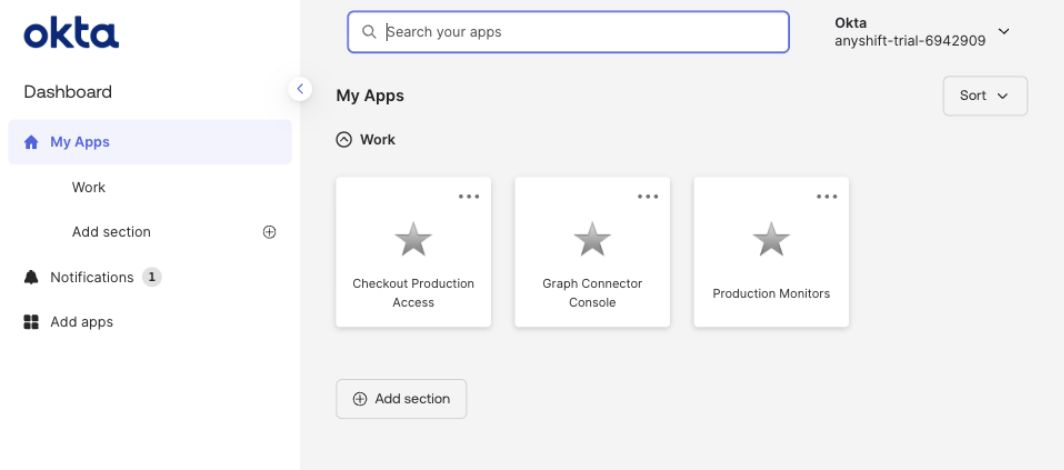
Read the two artifacts together: the Anyshift review explains what the access can reach in production; Okta shows the access that actually lands for the user. In this sandbox, the Production Access Demo group grants three downstream surfaces: Checkout Production Access, Graph Connector Console, and Production Monitors.
Okta first notifies the demo user that new apps were assigned:
The same access then appears in the Okta dashboard:
Where Okta Ends And Reachability Begins
Okta already gives teams the identity and governance layer: users, groups, app assignments, policies, System Log events, and products like Access Requests. That is exactly where access should be requested, governed, and written.
Production reachability crosses systems that identity products usually reference but do not own:
- cloud roles and IAM Identity Center mappings;
- Kubernetes workloads and namespaces;
- service ownership;
- monitors and recent deploys;
- dependency paths and blast radius.
Anyshift joins those systems into a live production graph. For Okta access changes, the graph adds the missing edge detail: "This group grants this app or role, which reaches these workloads, owned by these teams, watched by these monitors."
What Teams Get
Security and platform teams keep Okta as the access surface and add richer production evidence around it:
- See production reach before changing access: which services, owners, monitors, and dependencies sit behind the group.
- Bring production owners better evidence: especially when the group touches incident response, deploy, or admin surfaces.
- Keep Okta as the system of record: identity state still changes in Okta, with Anyshift supplying context around the change.
The next nearby workflows follow the same shape: enrich Okta System Log events with production blast radius, attach reachability context to Access Request decisions, or auto-revoke temporary incident groups when the incident closes.
If your team uses Okta and wants production reachability enrichment for access changes instead of a group-only view of what gets granted, contact us.