Annie is Anyshift's CLI for reviewed workflows. In this example, it writes production context into ServiceNow through the native Table API, which updates records such as incidents, work notes, change requests, and change tasks.

Summary
ServiceNow ITSM is where operations teams record incidents, keep work notes, approve changes, and assign follow-up tasks. Here, checkout latency appears after an RDS parameter group change: an `incident` captures the symptom, a `change_request` holds the rollback, and a `change_task` asks the owner to review.
Anyshift enriches that incident with the production facts behind the symptom: what changed, which services are affected, what the blast radius is, and who should review. That context makes the ServiceNow note, rollback change, and owner task more useful than a ticket that only says checkout is slow.
The Workflow
Checkout gets slow after an RDS parameter group change. Anyshift links the ServiceNow incident to the production chain:
- The ServiceNow
incidentcaptures the checkout latency symptom. - PR
platform-infra#1923changedterraform/prod/rds/checkout/parameter-group.tf. checkout-apiandbilling-workershare the affected database.- The billing team reviews the rollback before the database setting changes again.
Before writing back to ServiceNow, Anyshift keeps only the facts needed for the next action: what changed, what is affected, who owns it, and what should happen next.
Those facts become the ServiceNow work note, rollback change request, and owner task. In this run, ServiceNow gets a rollback change for the RDS parameter group, plus a billing review task because billing-worker uses the same database as checkout.
How Anyshift Writes Into ServiceNow
The operator gives one request:
annie do "for ServiceNow incident INC0012345, add production evidence and create a reviewed rollback change"annie do gathers the production context and drafts the ServiceNow updates: the incident work note, the rollback change request, and the billing review task. The operator sees those draft writes before anything is sent through the Table API.
The generated review is intentionally small:
# Generated by annie do
# ServiceNow production-impact review
decision: open reviewed rollback change; request owner review
suspected_change:
  pr: platform-infra#1923
  path: terraform/prod/rds/checkout/parameter-group.tf
affected_services:
  - checkout-api      owner: payments-platform
  - billing-worker    owner: billing-platform
servicenow_writes:
  - PATCH /api/now/table/incident/:sys_id
  - POST  /api/now/table/change_request
  - POST  /api/now/table/change_task
review: before ServiceNow writes
After approval, Anyshift sends authenticated Table API calls to ServiceNow: PATCH the incident with the work note, then POST the change_request and change_task. ServiceNow stores the note in sys_journal_field, so the user still sees a normal ServiceNow incident, note, change request, and task.
The Result In ServiceNow
The ServiceNow result is visible in the records below: incident INC0010003 is updated, the Anyshift review is written into work notes, rollback change CHG0030001 is created, and owner review task CTASK0010001 is opened.
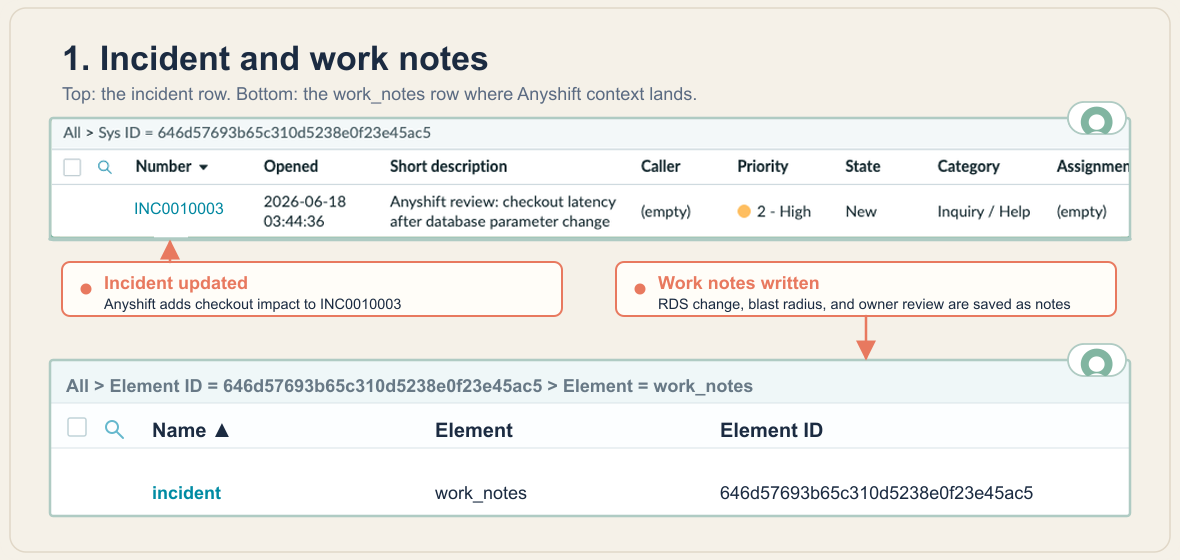
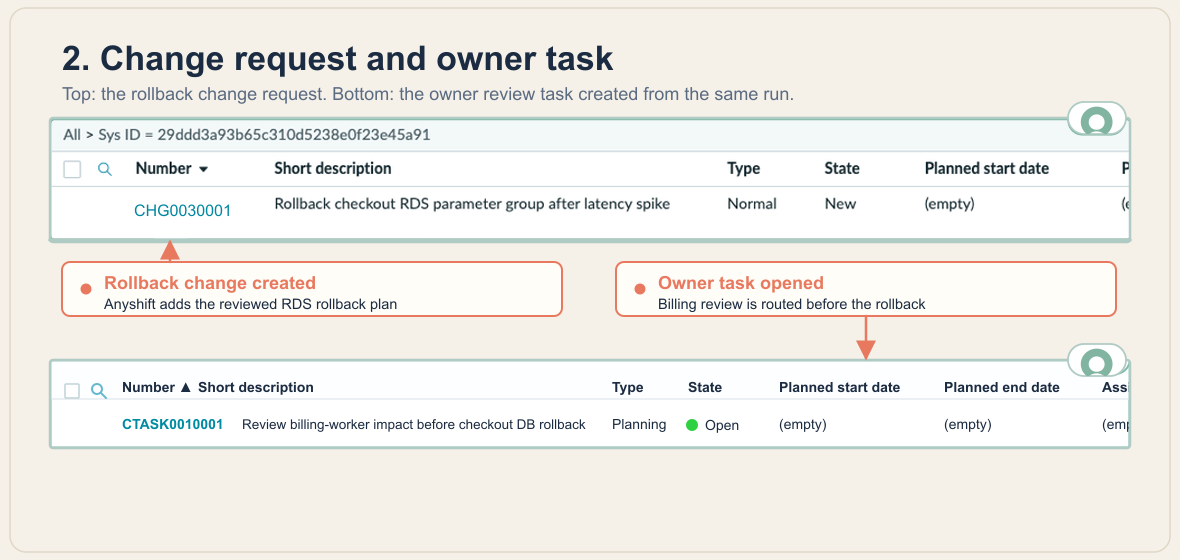
These screenshots show the ServiceNow side: records landed in the native tables. The Anyshift review above shows the production context used to create them.
What Teams Get
The practical gain is production context attached to the ServiceNow workflow.
- On-call teams see the suspected cause in the work notes.
- Change owners get a rollback plan with blast radius attached.
- Impacted teams get review tasks before a shared dependency changes.
- Agents and automation get production context before they act.
Where This Goes Next
Action Fabric context call. Use Anyshift as a context source for blast radius when a ServiceNow agent runs an approved action.
Incident workspace panel. Show recent infra changes, affected owners, and rollback context beside the incident.
If your team uses ServiceNow and wants incidents, changes, and agent actions enriched with production context, contact us.