TL;DR: Postman Collections run API checks with Environments and scheduled Monitors. Anyshift adds the production graph first: live consumers, owners, monitors, and sandbox paths to skip.

Why Postman Workflows Need Production Context
Postman owns the API workflow: collections hold requests and tests, environments hold run values, and monitors can schedule checks continuously.
What Postman does not automatically know is production impact. From one changed payments-api path, it cannot infer that checkout-api, fraud-scoring, and billing-worker are the production paths to test, or that sandbox-consumer should stay out of the release signal.
Anyshift adds that graph before Postman is written. Postman proves API behavior. Anyshift tells Postman which production behavior deserves proof.
The Integration Scenario
This workflow has two layers:
- The application context is a demo checkout system. The service graph is fixture data, but the shape is deliberately realistic: a customer-facing checkout flow calls a payment API, a fraud service consumes the payment decision, and a billing worker reconciles the result later.
- The Postman side is real. The workflow created a real collection and environment in a Postman workspace through the Postman API. The endpoint values are placeholders, so the article shows object creation instead of pretending a scheduled cloud run is production evidence.
The starting change is PATCH /payment-methods/{id} in payments-api. In the service graph, that one endpoint is connected to:
checkout-api, the customer-facing checkout authorization pathfraud-scoring, which depends on the payment authorization outcomebilling-worker, which reconciles authorized payments latersandbox-consumer, which looks relevant but only receives non-production traffic
The stake is simple: if the release gate only tests payments-api in isolation, the API team can get a green check while the real checkout path is still under-tested. Anyshift turns that provider endpoint change into a Postman test pack for the paths that can actually hurt customers.
The Context Anyshift Adds
For this change, Anyshift takes the provider endpoint and resolves the production chain around it:
- Affected path:
checkout-apicallsPATCH /payment-methods/{id}on the production checkout authorization path. - Downstream consumer:
fraud-scoringdepends on the payment authorization outcome before checkout completes. - Reconciliation path:
billing-workerreconciles authorized payments after checkout. - Owners:
payments-platform,risk-platform, andrevenue-platform. - Monitors:
checkout_error_rate,payment_authorization_latency,fraud_decision_latency, andbilling_reconciliation_lag. - Skipped path:
sandbox-consumer, because it has non-production traffic only.
That is the relationship Postman cannot infer from the endpoint alone. The question before writing the workflow is: which consumers, owners, monitors, and skipped paths should shape the API checks?
How Anyshift Writes Into Postman
The workflow owner starts with a short intent:
annie do "create a Postman production-impact collection for the payments-api change"annie do is Anyshift's reviewed workflow surface. It asks the Anyshift graph for the production-impact facts, renders deterministic Postman payloads, and stops before the native write.
Before Postman receives anything, the generated review starts with production impact, not API mechanics:
api: payments-api
change: PATCH /payment-methods authorization retry behavior
include:
  checkout-api -> owner payments-platform -> checkout_error_rate
  fraud-scoring -> owner risk-platform -> fraud_decision_latency
  billing-worker -> owner revenue-platform -> billing_reconciliation_lag
skip:
  sandbox-consumer -> non-production traffic only
This is the control point: the workflow owner can proceed, add another consumer, narrow a monitor, or stop before a weak API check becomes a false release signal.
After approval, annie-cli uses the Postman API to create or update:
- the collection
Anyshift production-impact tests for payments-api - the environment
Anyshift production-impact demo
The collection is not a generic payments-api inventory. It contains checkout, fraud, and billing checks because the graph maps those paths to the release risk. Credentials stay local: the workflow reads POSTMAN_API_KEY and POSTMAN_WORKSPACE_ID; it does not bake secrets into the article, fixture, or runbook.
The investigation returns structured impact data; Go renders the Postman collection, environment, and API calls deterministically.
The Result In Postman
In our Postman workspace, the workflow created the native objects through the Postman API:
- a collection with the three production-impact requests
- an environment with
base_url,payment_method_id, andcustomer_id
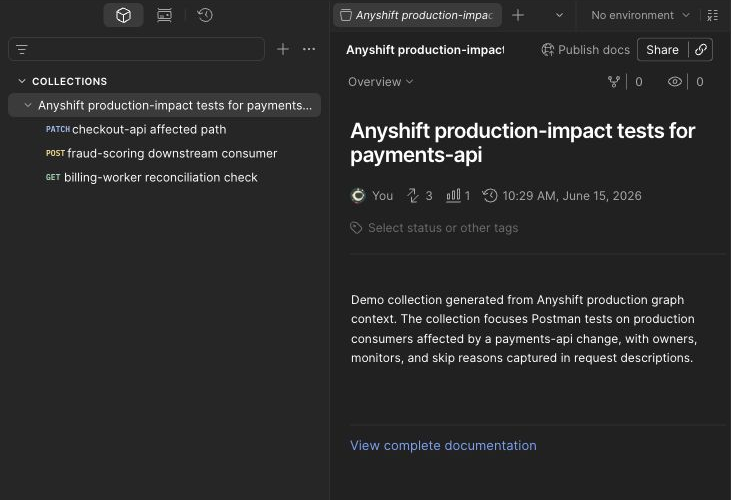
The collection screenshot is the native Postman result: one request for the checkout path, one for the fraud consumer, and one for billing reconciliation. Those names come from the Anyshift graph selection above.
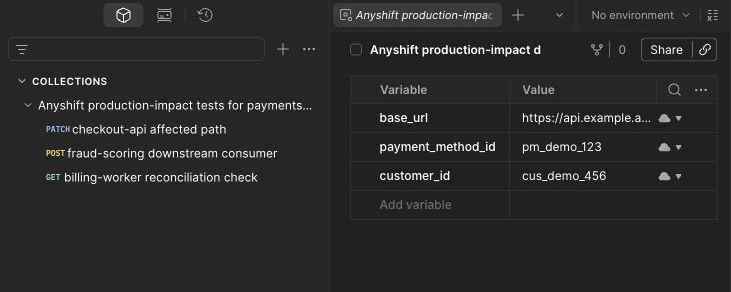
The environment uses demo values because the article is not running checks against a fake public service. In a real workspace, where base_url points to a reachable staging or production-safe endpoint, the same collection can be attached to scheduled runs or monitors.
The table below ties each generated request back to the production reason it exists:
| Postman object | Production context Anyshift adds | Release decision |
|---|---|---|
checkout-api affected path | checkout-api, payments-platform, checkout_error_rate | Must pass before rollout. |
fraud-scoring downstream consumer | risk-platform, fraud_decision_latency | Include because authorization outcome drives fraud decision. |
billing-worker reconciliation check | revenue-platform, billing_reconciliation_lag | Include because retries affect reconciliation lag. |
sandbox-consumer | Non-production traffic only | Skip from the release signal. |
Postman still owns the API workflow. The difference is that each object now has a concrete production reason before it becomes a release signal.
Why This Matters
A passing API test can still be incomplete if it did not include the consumer path that matters. A monitor can still be noisy if it watches a sandbox-only path. A release gate can still create false confidence if it only follows endpoint inventory.
That same gap appears in API lifecycle platforms that own specifications, contract checks, tests, documentation, release gates, or monitors. The platform manages the API artifact. Anyshift answers whether the artifact reflects live production risk.
- API owners get collections that reflect live consumers, not just endpoint inventory.
- Platform teams can explain why each request belongs in the workflow.
- On-call teams see monitors tied to the production paths that can break.
- Non-production consumers stay out of the release signal.
For teams using Postman, the win is simple: API checks that reflect production impact, not just API inventory.
Next Postman Integration Points
Contract-test targeting. Use production dependency context to decide which consumer contracts should run for a provider change before CI burns time on the wrong set.
Release-gate evidence. Attach owners, affected services, monitor coverage, and skipped paths to the API release gate before the rollout.
Monitor drift review. Compare production traffic and monitors against tested API paths, then route missing checks back into Postman.
If your team uses Postman and wants production-impact API checks instead of manually guessing which collections and monitors need updates, contact us.