GitLab merge requests are the control point for reviewing code changes, discussions, and approvals. The workflow below uses GitLab's Notes API to put production-impact context directly into that review surface.
Summary
GitLab is where teams decide whether a code change is ready to merge. It can show the diff, pipeline state, discussions, approvals, and security findings. The missing question is production scope: which running services depend on this change, who owns them, and who should review before merge?
In this workflow, a merge request changes shared/auth/session.js, a shared session validation module. GitLab shows the code change. Anyshift maps that change through the production graph and finds three affected production services: checkout-service, notification-worker, and inventory-sync. It skips sandbox-auth because that workload is not production.
The result is intentionally small: one production-impact note inside the GitLab merge request, before approval. GitLab remains the review surface. Anyshift supplies the production truth the reviewer cannot infer from the repository alone.
The Problem
A merge request can tell a reviewer what changed in code. It cannot always tell them what that code means in production.
That gap matters most for shared modules. A small change to shared/auth/session.js can affect checkout authorization, notification dispatch, and catalog sync, even when the merge request itself only shows a local diff. A reviewer can search imports, but import search still misses live deployment state, ownership, dependency paths, and services that exist only in sandbox environments.
For a platform owner or reviewer, the real decision is not "does this diff look reasonable?" It is: can this be merged without surprising the teams that run the affected services?
The Context Anyshift Adds

The flow is the same shape as the Databricks workflow: start from the native vendor object, map it through Anyshift's production graph, then write the reviewed result back into the vendor surface.
For GitLab, Anyshift connects the merge request to live production context:
checkout-service, owned byPayments, uses the changed session validation path for checkout authorization.notification-worker, owned byNotifications, checks active sessions before dispatch.inventory-sync, owned byCatalog, authorizes inventory updates through the same gate.sandbox-authis excluded because it is not a production workload.
The connection is made as an evidence chain, not as a single GitLab field. GitLab provides the merge request diff. Anyshift maps the changed file into the code dependency graph, maps those code paths to services, then joins those services to the runtime graph, ownership metadata, environments, monitors, and recent changes.

That is what makes the relationship realistic: shared/auth/session.js is not just "a changed file." It is an imported module used by checkout-service; checkout-service maps to production workloads; those workloads carry environment, monitor, and ownership context; and the same chain pulls in notification-worker and inventory-sync. sandbox-auth is excluded because the runtime metadata marks it as non-production.
That context is not a GitLab object. GitLab owns merge requests, discussions, approvals, pipelines, and repository history. Anyshift owns the production graph that joins code paths to running services, owners, environments, monitors, recent changes, and blast radius.
How Anyshift Writes Into GitLab
The workflow starts from Anyshift's reviewed CLI surface:
annie do "review GitLab MR !1 for production impact: map shared/auth/session.js to running services, skip non-prod, and draft the MR note"annie do is the way Anyshift turns graph context into a reviewed action. It starts from a specific merge request and changed path, gathers the affected services, and renders the note body, but the write path stays native to GitLab. The handoff has three steps: map the MR diff to production services, review the exact note body, then post it into the merge request conversation.
After review, the runbook posts the note through GitLab's merge request note endpoint:
POST /projects/:id/merge_requests/:merge_request_iid/notesThat boundary is the important part: Anyshift decides what production context belongs in the review; GitLab owns where the review happens.
The Review Boundary
Before anything is posted, the workflow owner reviews the exact note that will land in GitLab: the affected services, owners, evidence, skipped workloads, and recommendation.

The runbook is the contract. The GitLab token stays local, the note is saved before the write, and the operator can stop before posting. This keeps the workflow human-verified while still putting the final context where reviewers already work.
The Result In GitLab
In a controlled GitLab project, Anyshift created a real merge request, then posted the production-impact review through the GitLab API. The screenshot below is the actual GitLab merge request note.
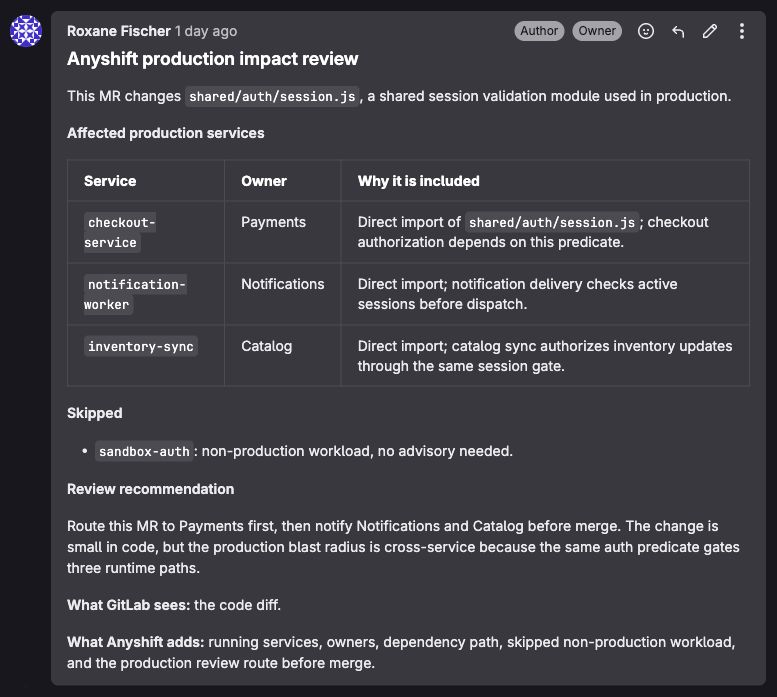
The reviewer no longer has to infer production blast radius from code search. The merge request now carries the production review route: Payments first, then Notifications and Catalog before merge. The decision stays in GitLab, but the decision is made with production context.
Why Import Search Is Not Enough
Import search answers a repository question: "who imports this file?"
Production review needs a different join:
- which importing services are actually running
- which environment each service runs in
- which team owns each production path
- which monitors or SLOs would show impact
- which workloads should be skipped because they are sandbox-only, deprecated, or not deployed
Anyshift supplies that join. GitLab keeps the merge request, discussion, and approval flow. The reviewer gets production impact without leaving GitLab.
What Teams Get
Reviewers see production scope before approval. Service owners get pulled in because the graph says their service is affected, not because someone remembered a stale ownership list. Platform teams get a lightweight control point before shared code lands.
This also gives GitLab AI workflows better ground truth. GitLab's Duo Agent Platform brings agentic assistance into the software lifecycle. Anyshift adds the production layer those agents need before applying a fix, opening a merge request, or recommending a review route.
Where This Goes Next
The first useful verb is simple: post production impact where code review happens.
This also points to Annie Identity. Once the graph knows that a changed path reaches Payments, Notifications, and Catalog, Identity would resolve the right humans and teams across GitLab, Slack, and on-call systems. The next step is not just saying "these services are affected"; it is routing the merge request review to the service owners who can safely approve it.
Nearby verbs are natural:
- use Annie Identity to route the merge request to the right service owners
- open a follow-up issue when a production dependency has missing coverage
- block or escalate a risky agent-generated fix until the affected owner reviews the blast radius
If your team uses GitLab and wants production-aware merge requests instead of manual import search and stale ownership guesses, contact us.