TL;DR: CrowdStrike Falcon is where security teams decide what to do with suspicious domains, IPs, and files. Anyshift adds the production context behind that signal: affected service, owner, recent deploy, dependencies, and non-production systems to skip before the reviewed action is sent to Falcon through its API.
Why CrowdStrike Workflows Need Production Context
CrowdStrike is where security teams detect, investigate, and act on endpoint risk. In this article, the CrowdStrike side has four moving parts:
- Falcon is the native security surface where analysts manage endpoint protection and response.
- IOC Management is the Falcon workflow for custom indicators such as domains, IPs, and hashes.
- The Falcon API is the native write path Anyshift uses after review.
- Falcon host groups, actions, severity, platforms, expiration, and comments decide how broadly an indicator should apply.
The missing context is production impact. Falcon can store the indicator, action, severity, platforms, expiration, and host scope. It does not automatically know which production service introduced the egress path, which owner should approve escalation, which dependencies are in the blast radius, or which non-production services should be skipped.
Anyshift adds that missing production graph. In this workflow, Anyshift's annie do review step gathers live production context, renders a human-readable handoff, and writes a detect-only custom IOC into Falcon through the native API.
A Suspicious Checkout Domain In Falcon
Example: a SOC analyst is reviewing crowdstrike-anyshift-demo.example.com, a suspicious egress domain observed after deploy-2026-06-10.
Inside Falcon, that is an indicator decision: should this domain be allowed, detected, prevented, scoped to a host group, or left alone?
In production, it is also a customer-path decision. The domain is connected to checkout-api, owned by payments-platform, with payment-worker, fraud-score, and orders-api in the blast radius. If the action moves from Detect only to Prevent, the wrong scope can affect checkout.
The question before the action is simple: which services, owners, dependencies, and environments should shape the Falcon IOC decision?
What Anyshift Adds To The Falcon Review

For the checkout egress workflow, Anyshift maps the Falcon-visible indicator to the production systems behind it:
checkout-api, owned bypayments-platform, opened the new outbound callback afterdeploy-2026-06-10.payment-worker,fraud-score, andorders-apistay in scope if the indicator moves fromDetect onlytoPrevent.checkout-api-devis skipped because it is a non-production namespace.
The important relationship is not visible from the indicator alone: domain IOC -> outbound callback -> checkout-api deployment -> payments-platform owner -> checkout dependencies -> production-only scope.
That is the production context a Falcon workflow needs before an IOC becomes an endpoint action.
How Anyshift Writes Production Context Into Falcon
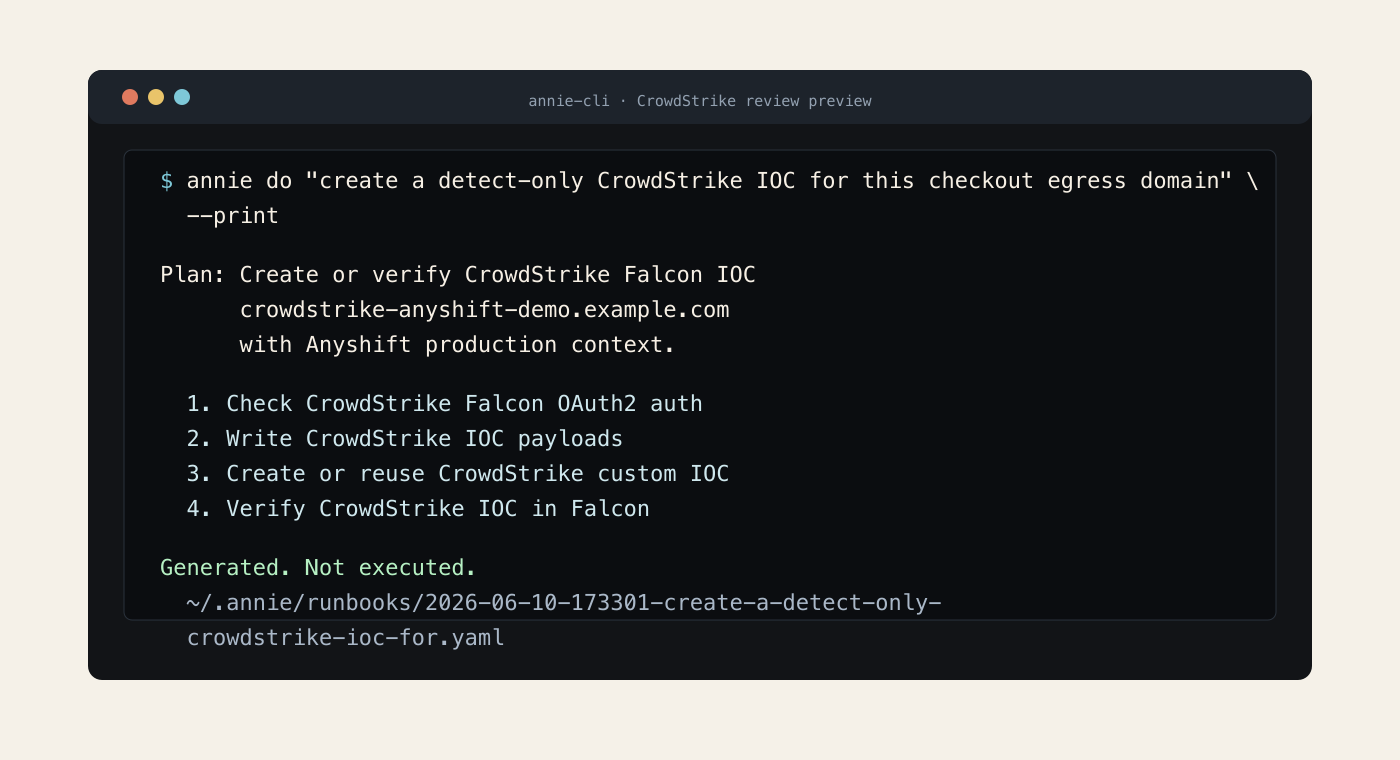
The analyst starts with a plain-English request:
annie do "create a detect-only CrowdStrike IOC for this checkout egress domain"annie do is Anyshift's reviewed workflow surface. It asks the Anyshift graph for affected production services, owners, dependencies, recent changes, evidence, and skip rules. Then annie-cli renders deterministic Falcon API steps. There is no LLM in the repetitive command layer.
Before Falcon receives the write, the generated review starts with production impact, not API mechanics:
indicator: crowdstrike-anyshift-demo.example.com
recommended_action: detect
owner: payments-platform
recent_change: deploy-2026-06-10
blast_radius: checkout-api, payment-worker, fraud-score, orders-api
skip: checkout-api-dev because it is non-production
This is the control point: the analyst can proceed with Detect only, narrow the scope, require owner approval, or stop before the indicator becomes a broader endpoint action.
After approval, the write path uses Falcon's native API:
GET  /iocs/combined/indicator/v1
POST /iocs/entities/indicators/v1?ignore_warnings=true
GET  /iocs/combined/indicator/v1
The credentials stay in the operator's environment. The prototype reads FALCON_CLIENT_ID, FALCON_CLIENT_SECRET, and FALCON_CLOUD; it does not bake secrets into the article, fixture, or runbook.
The Result In CrowdStrike
The workflow created a real Falcon indicator in the US-2 tenant. The native Falcon fields show the security object: one suspicious domain, action Detect only, host group All hosts, severity High, and expiration Jun. 17, 2026.
The Anyshift result lands on that same Falcon IOC as Description and Tags. The description carries the production graph context; the tags carry service, owner, environment, and deploy context.
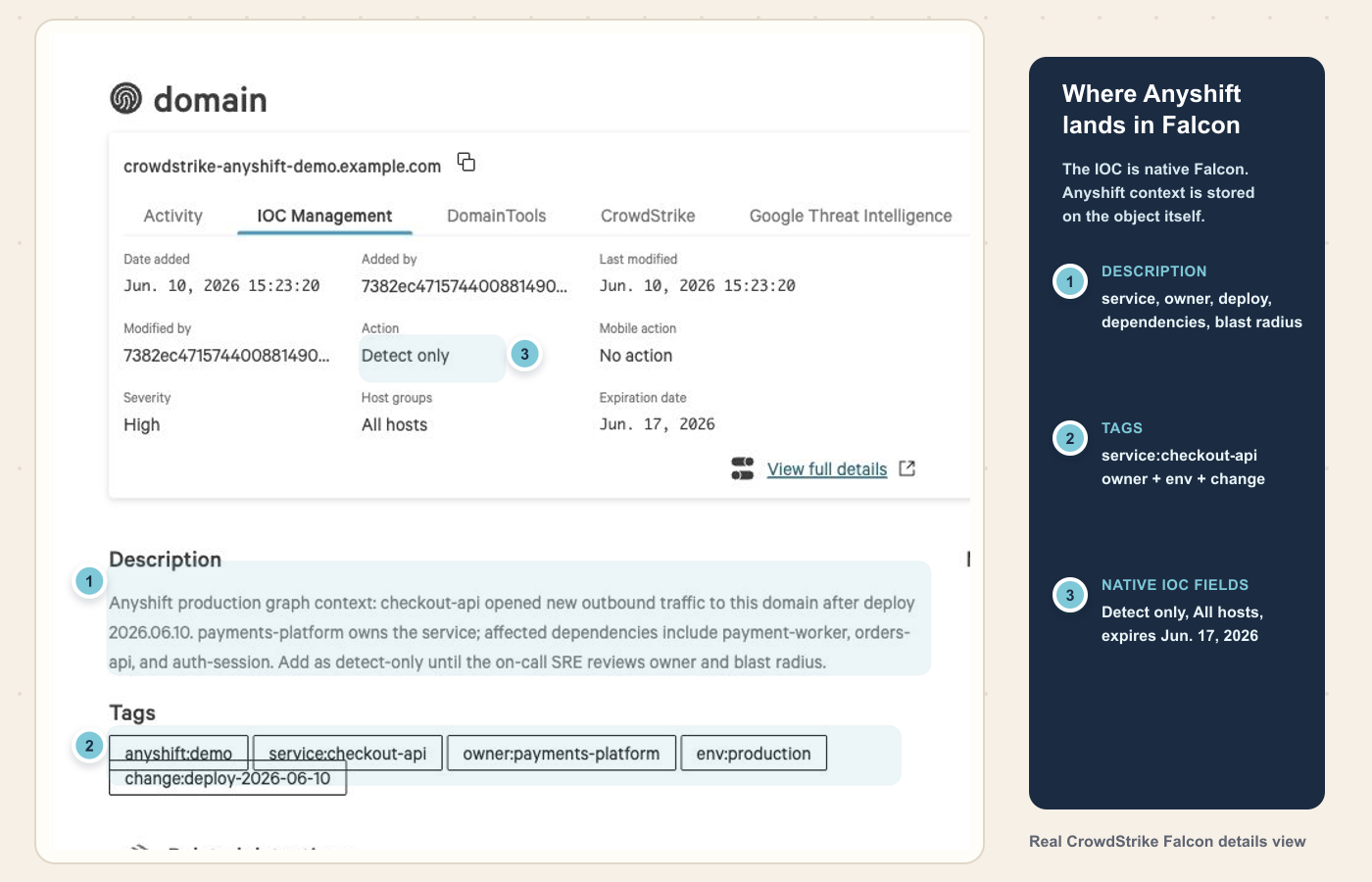
That Falcon view is the CrowdStrike proof point. Anyshift does not replace Falcon's indicator store, policy model, or analyst workflow. It writes the production review onto the Falcon object: what service introduced the signal, who owns it, what depends on it, and what should stay out of scope.
| Falcon object | Production context Anyshift adds | Review decision |
|---|---|---|
crowdstrike-anyshift-demo.example.com | checkout-api, payments-platform, deploy-2026-06-10 | Register as Detect only. |
payment-worker, fraud-score, orders-api | Downstream production dependencies | Keep in blast-radius note before escalation. |
checkout-api-dev | Non-production namespace | Skip from the IOC decision. |
Falcon can now hold the security action while the review names why the indicator matters and who owns the path.
Why IOC Management Misses Runtime Impact
Falcon IOC Management is the right place to register indicators and decide whether endpoints should detect or prevent. CrowdStrike's API supports structured fields such as indicator type, action, severity, source, tags, platforms, expiration, and comments.
The gap is production meaning. A domain IOC can be valid and still be under-contextualized. Falcon does not automatically know that checkout-api introduced the egress path, that payments-platform owns the review, that fraud-score is a dependency, or that checkout-api-dev should be excluded from the decision.
Anyshift adds those facts before the write. Falcon owns the security action.
What Security And Platform Teams Get
Security teams keep working in Falcon. Platform teams keep their production truth in Anyshift. The two meet when an indicator decision needs production judgment.
Before an IOC is created, scoped to a host group, escalated from Detect only to Prevent, or handed to an incident workflow, Falcon can receive:
- affected production services
- owners who should approve escalation
- dependencies in the blast radius
- recent deploys and evidence
- non-production paths to exclude
- whether the action should detect, prevent, narrow scope, or stop for review
For users using CrowdStrike, the win is simple: endpoint actions that also understand live production impact.
Next CrowdStrike Integration Points
IOC severity updates. Anyshift can raise or lower severity when the production graph shows whether the indicator touches a customer-facing path.
Host-group scoping. When Falcon host groups are available, Anyshift can scope an IOC to production services instead of applying it globally.
Detection handoffs. For real detections or incidents, Anyshift can add the same service, owner, dependency, and recent-change context before assignment, tagging, status changes, or containment review.
If your team uses CrowdStrike and wants production graph context in Falcon IOC decisions instead of manual owner and blast-radius lookup, contact us.